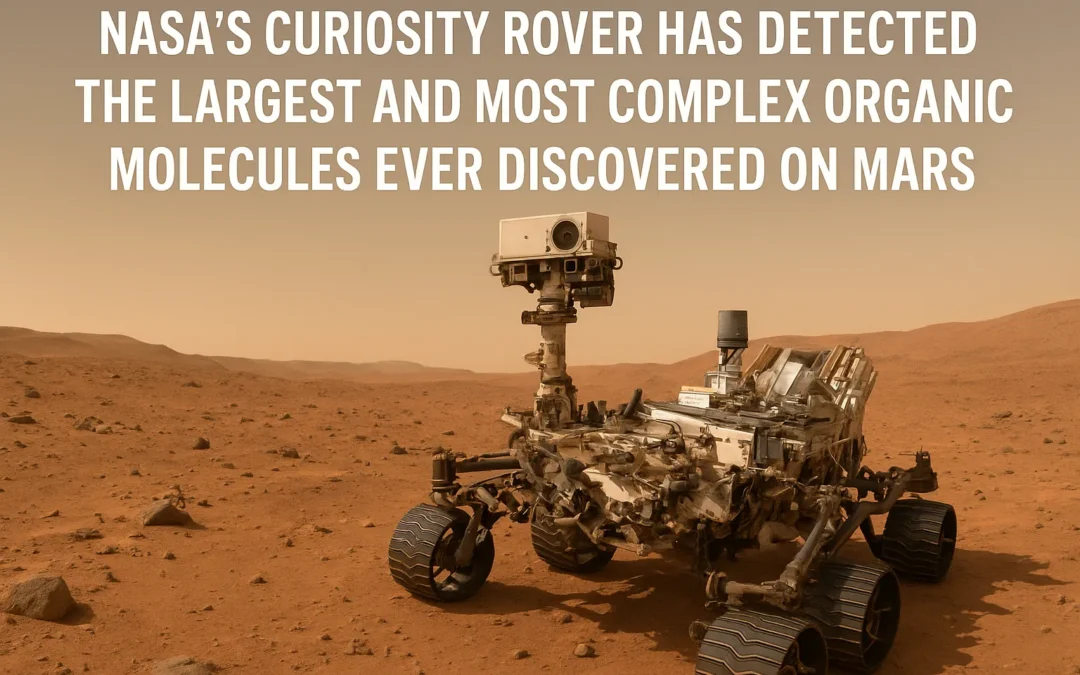
How NASA’s Curiosity Rover Detected the Largest and Most Complex Organic Molecules Ever Discovered on Mars
NASA’s Curiosity rover identified the largest and most complex organic molecules ever detected on Mars by analyzing drilled rock samples from ancient lakebed deposits inside Gale Crater. The rover targeted fine-grained mudstone formations, which are known on Earth to preserve organic material effectively. By drilling into these sedimentary rocks and delivering powdered samples to its onboard laboratory, Curiosity was able to search for carbon-based compounds that may have been preserved for billions of years.
The key instrument behind this discovery is the Sample Analysis at Mars (SAM) suite. SAM uses a combination of gas chromatography, mass spectrometry, and tunable laser spectrometry to heat samples and analyze the gases released. When the powdered rock is heated in a process called pyrolysis, complex organic molecules break down into smaller fragments. These fragments are then separated and identified based on their chemical signatures, allowing scientists to determine the presence of large carbon-containing structures embedded within the Martian rock.
Advanced Chemical Techniques Used by Curiosity
To enhance detection, SAM can also perform specialized chemical processing that helps identify more complex molecules that might otherwise degrade during heating. These methods allow scientists to detect:
- Longer carbon-chain compounds
- Aromatic organic molecules
- Sulfur-bearing organic compounds that are more resistant to radiation
The discovery of these complex organics suggests that ancient Martian environments, particularly those associated with long-standing water activity, were capable of preserving intricate carbon chemistry. By combining targeted drilling, careful sample handling, and high-precision laboratory analysis onboard the rover, Curiosity provided the strongest evidence yet that Mars once hosted the chemical ingredients necessary for life.
What Are the Newly Discovered Organic Molecules on Mars and Why Are They Significant?
Recent Mars missions, including NASA’s Curiosity and Perseverance rovers, have identified a range of complex organic molecules preserved in Martian rocks and sediments. These include carbon-based compounds such as aromatic molecules, thiophenes, and other stable organic structures detected in ancient lakebed deposits. Organic molecules are chemical compounds that contain carbon and are considered essential building blocks for life, though they can also form through non-biological processes.
Types of Organic Molecules Found on Mars
- Aromatic hydrocarbons – Stable ring-shaped carbon molecules found in sedimentary rocks.
- Thiophenes – Sulfur-containing organic compounds identified by Curiosity’s onboard laboratory instruments.
- Macromolecular organic matter – Larger, complex carbon-based materials preserved in clay-rich rocks.
These discoveries are significant because they show that Mars once had the chemical ingredients necessary for life. The organic compounds were detected in ancient environments believed to have contained liquid water, such as river deltas and lakebeds in Gale Crater and Jezero Crater. Clay minerals and sediment layers helped protect these molecules from radiation and harsh surface conditions, allowing them to persist for billions of years.
The presence of preserved organic matter also strengthens the case that early Mars may have been habitable. While the detection of organic molecules does not prove past life, it confirms that key chemical components required for life existed on the planet. This makes Mars one of the most compelling targets in the search for ancient extraterrestrial life and supports ongoing efforts to return Martian rock samples to Earth for more detailed analysis.
Could These Complex Organic Compounds Be Evidence of Ancient Life on Mars?
The discovery of complex organic compounds on Mars has sparked intense scientific interest because such molecules are considered fundamental building blocks of life. Organic compounds contain carbon and are often associated with biological processes on Earth. However, their presence alone does not automatically confirm life, as these molecules can also form through non-biological, or abiotic, chemical reactions. The key question scientists are exploring is whether the structure, distribution, and context of these compounds point toward biological origins or purely geological processes.
What Makes Organic Molecules Significant?
Complex organic molecules become especially intriguing when they display characteristics commonly linked to life, such as:
- Structural complexity resembling biological macromolecules
- Specific molecular patterns that are difficult to produce through simple chemical reactions
- Association with ancient water-rich environments, where life could potentially have emerged
On Earth, similar compounds are often tied to microbial activity or the breakdown of once-living organisms. When such molecules are found in Martian rocks that formed billions of years ago—during a time when the planet likely had liquid water—the possibility of ancient microbial life becomes scientifically compelling.
Another important factor is the geological context in which these compounds are discovered. If organic molecules are preserved in sedimentary rocks that were once lakebeds or river deltas, this strengthens the hypothesis that Mars may have once supported habitable conditions. Scientists also analyze whether the compounds show signs of alteration by radiation or chemical reactions over time, which can help determine their age and potential origin.
Despite their promise, complex organic compounds alone are not definitive proof of ancient life on Mars. Researchers must carefully distinguish between biological and non-biological pathways that could produce similar molecules. Ongoing analysis, laboratory simulations, and future sample-return missions aim to clarify whether these intriguing compounds represent chemical precursors to life—or actual evidence of a once-living Martian biosphere.
What This Breakthrough Means for Future Mars Missions and the Search for Extraterrestrial Life
The implications of this breakthrough are significant for the next generation of Mars exploration missions. By improving how scientists detect, analyze, or interpret potential biological signatures, it enhances mission planning, instrument design, and landing site selection. Future rovers and orbiters can be equipped with more advanced tools tailored to build on these findings, increasing the likelihood of identifying meaningful chemical or geological indicators linked to past or present life.
Advancing Life-Detection Technologies
This development also strengthens the scientific framework behind life-detection strategies on Mars. Refined detection methods reduce uncertainty and help distinguish between biological and non-biological processes. As a result, mission teams can better prioritize samples, drilling locations, and return missions aimed at bringing Martian material back to Earth for detailed laboratory analysis. These advancements improve data reliability and minimize false positives in the search for extraterrestrial organisms.
Shaping Long-Term Exploration Goals
Beyond Mars, this breakthrough influences the broader search for extraterrestrial life in our solar system. Lessons learned can be applied to missions targeting icy moons, subsurface oceans, or other potentially habitable environments. By strengthening scientific models and exploration techniques, space agencies can design more focused astrobiology missions, optimize budgets, and increase international collaboration in the pursuit of answering one of humanity’s most profound questions.
As future missions integrate these insights, the pathway toward identifying credible biosignatures becomes clearer, helping researchers refine exploration priorities and deepen our understanding of planetary habitability.
Inside the Science: How Curiosity Analyzes Martian Soil to Uncover Organic Molecules
NASA’s Curiosity rover uses a sophisticated suite of scientific instruments to study Martian soil and search for organic molecules on Mars. At the heart of this investigation is the Sample Analysis at Mars (SAM) laboratory, a miniaturized chemistry lab built directly into the rover. SAM is specifically designed to detect carbon-based compounds, which are considered essential building blocks of life. By heating soil and rock samples and analyzing the gases released, Curiosity can identify the chemical signatures of organic materials embedded within the Martian surface.
The Role of Drilling and Sample Collection
Curiosity collects Martian soil and powdered rock samples using its robotic arm and drill system. Once a target is selected, the rover:
- Drills into rock formations to extract fine powder
- Transfers the sample to onboard laboratory instruments
- Screens and portions the material for precise analysis
This careful preparation ensures that the samples are free from large debris and ready for high-precision chemical testing. The ability to drill beneath the surface is crucial, as subsurface materials are better shielded from harsh radiation that can destroy organic compounds.
Inside the SAM instrument, samples are gradually heated in a process called pyrolysis. As temperatures rise, gases are released and funneled into a gas chromatograph and mass spectrometer. These tools separate and identify molecules based on their chemical properties and mass-to-charge ratios. By examining these patterns, scientists can detect complex organic compounds such as thiophenes, chlorobenzenes, and other carbon-based molecules preserved in ancient Martian sediments.
Curiosity also uses the Chemistry and Mineralogy (CheMin) instrument to analyze the mineral structure of Martian soil. Understanding the mineral context helps scientists determine how organic molecules may have been preserved over billions of years. Clay minerals, for example, are known to trap and protect organic material from radiation and oxidation, making them prime targets in the ongoing search for evidence of past habitability on Mars.
Array