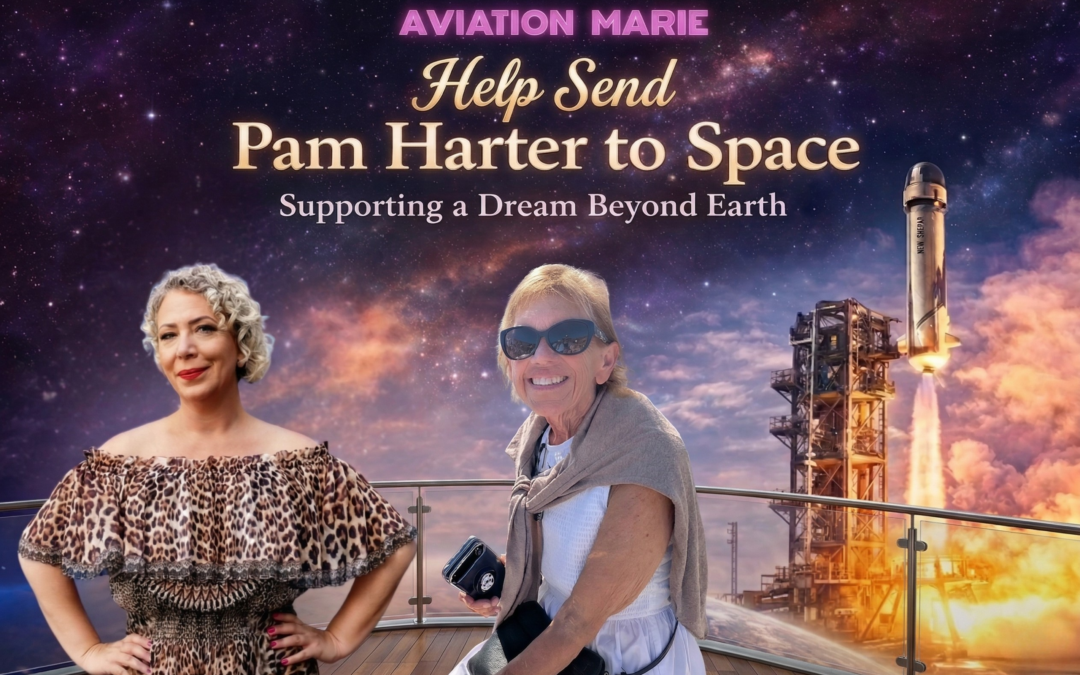
The Mission to See Earth from Space
In Napa Valley, California, where the horizon opens into quiet skies and long stretches of light, Pam Harter still finds herself looking up.
It is a habit that has followed her throughout her life.
For decades, space represented something distant yet deeply familiar. Like many who grew up watching the early milestones of human space exploration, Pam was captivated by the idea of leaving Earth — even for a moment — to see it from above. The vastness, the silence, the perspective. It stayed with her.
Today, at 69, that lifelong fascination has taken on a new and deeply personal meaning.
Living Under Hospice Care
Pam is living with a terminal genetic illness and is currently under hospice care. For many, hospice is often misunderstood as a final stage defined by limitation. In reality, it is a model of care focused on quality of life, comfort, and the ability to live meaningfully in the present.
Pam has embraced that philosophy in her own way.
She speaks about her life not in terms of what is ending, but in terms of what remains possible.
And among those possibilities is a dream she has carried for years.
To see Earth from space.
The Mission: A Commercial Suborbital Spaceflight
Pam hopes to participate in a commercial suborbital spaceflight — a journey made possible by the growing field of private space travel. These flights travel beyond the recognized boundary of space, offering passengers a brief but extraordinary experience of weightlessness and a direct view of Earth’s curvature against the darkness of the cosmos.
For those who have experienced it, the impact is profound and lasting.
Astronauts often describe a psychological shift known as the Overview Effect. It is the moment when national borders disappear, and the planet is seen as one interconnected system. Fragile. Beautiful. Shared.
For Pam, the significance of that moment is not defined by the duration of the flight — but by what it represents.
After a lifetime of looking outward, it is the chance to look back.
Those close to her describe her as grounded, optimistic, and deeply present. Even as she navigates the realities of her condition, she continues to approach each day with intention. She plans. She reflects. She remains engaged with the world around her.
Her story is not one of resignation. It is one of perspective.
Redefining What Hospice Can Look Like
In pursuing this journey, Pam is quietly reshaping the narrative around hospice care. She demonstrates that even within this stage of life, there is room for aspiration, curiosity, and forward movement.
Hospice, in this context, is not an end. It is a space where meaning becomes more visible.
To support her mission, a fundraising effort has been created to cover the essential elements required for such a journey — including travel coordination, medical evaluations for spaceflight, and logistical preparation. The initial goal is $20,000.
But the response to her story suggests that its significance extends far beyond the financial aspect.
It raises broader questions about how we define time, possibility, and fulfillment.
What does it mean to pursue a dream when circumstances change?
What remains essential when everything else becomes uncertain?
Why This Story Matters — For All of Us
Pam’s journey offers one possible answer.
It suggests that the human instinct to explore, to understand, and to seek perspective does not disappear. It adapts. It deepens.
At Aviation Marie, where the focus often rests on innovation, aerospace advancement, and the future of exploration, stories like Pam’s serve as a reminder of something more fundamental.
Space is not only a destination. It is a reflection of human curiosity.
And sometimes, the most meaningful missions are not defined by distance or duration, but by intention.
Pam Harter’s mission is, in many ways, both deeply personal and universally human. A reminder that even in life’s most uncertain chapters, the desire to look up, to imagine, and to reach beyond remains.
Not as defiance. Not as denial.
But as the most natural expression of what it means to be alive.
The Science Behind the Overview Effect
The Overview Effect is not merely poetic language. It is a documented psychological phenomenon, formally described by author and space philosopher Frank White in his 1987 book of the same name. Researchers have since characterized it as a state of awe with self-transcendent qualities, triggered by the striking visual experience of seeing Earth from space. Those who have undergone it consistently report three defining elements: an intense appreciation of beauty, unexpected and overwhelming emotion, and a deepened sense of connection to all of humanity.
What makes this significant for Pam’s story is not just the experience itself, but what researchers believe it represents about the human mind. According to scientists studying the phenomenon, the Overview Effect triggers awe through both perceptual vastness — the physical sensation of seeing the planet from above — and conceptual vastness — the sudden, visceral understanding of what Earth truly is. For someone already living with deep intentionality, that shift of perspective carries a meaning that goes far beyond tourism.
What Commercial Suborbital Spaceflight Actually Looks Like
For those unfamiliar with the mechanics of a suborbital spaceflight, the experience is both brief and extraordinary. Flights of this kind travel to the recognized edge of space — approximately 50 to 100 kilometers above Earth — giving passengers several minutes of weightlessness and a direct, unobstructed view of the planet’s curvature set against the absolute darkness of space. The entire experience, from launch to landing, typically lasts between 11 and 90 minutes depending on the vehicle and operator.
Two companies have led the modern era of commercial suborbital spaceflight. Blue Origin’s New Shepard rocket has carried over 92 people to the edge of space across 17 crewed missions, though the company paused its tourism program in early 2026 to focus on lunar development. Virgin Galactic, which operates from Spaceport America in New Mexico, has taken 32 people to suborbital space across 12 missions and is preparing to resume flights in 2026 with its next-generation Delta-class spacecraft. Current ticket prices for suborbital experiences have ranged from $450,000 to over $1 million depending on the operator — a cost that underscores why fundraising support for journeys like Pam’s is not just symbolic, but essential.
Hospice Care: A Philosophy Often Misunderstood
One of the quieter yet most important dimensions of Pam’s story is what it reveals about hospice care itself. In the United States and across much of the world, hospice is frequently misunderstood as a passive surrender — a final door closing rather than a deliberate, values-centered choice. The reality is quite different. Hospice care is a specialized approach to end-of-life support that focuses on treating the whole person: managing physical symptoms, addressing emotional and spiritual needs, and preserving dignity throughout. As one foundational principle states, hospice affirms life but does not try to hasten or postpone death.
The philosophy behind hospice recognizes that the quality of the time remaining matters more than the quantity. It is not a setting but a commitment — and for many who embrace it, it becomes a framework for living more intentionally than ever before. Patients under hospice care continue to pursue relationships, creative projects, travel, celebration, and yes, extraordinary dreams. Pam Harter is one of many who have chosen to use this chapter not as a conclusion, but as a clarification — a moment to identify what truly matters and to move toward it.
The Broader Context: Space Tourism’s Growing Accessibility
Pam’s dream does not exist in isolation. It exists within a rapidly expanding industry that is slowly broadening who gets to participate in the experience of spaceflight. The global space tourism market, valued at approximately $1.61 billion in 2025, is projected to grow dramatically over the coming decade as reusable launch systems mature and more companies enter the field. What was once exclusively the domain of professional astronauts selected through rigorous government programs is increasingly open to civilians — people of varying backgrounds, ages, and physical conditions.
This evolution matters deeply for stories like Pam’s. It means that the question of who deserves to experience space is no longer answered only by physical performance metrics. It is being answered, slowly and meaningfully, by intention, significance, and the simple human desire to witness something transcendent. The medical evaluations required for spaceflight participants are thorough but designed to determine readiness — not to exclude those who live with illness. Each step toward greater accessibility in space travel is also a step toward a more honest conversation about who exploration is truly for.
When Time Becomes More Precise
There is something that terminal illness does to one’s relationship with time that is difficult to articulate from the outside. It strips away the assumption of indefinite future. It removes the comfortable postponement of the things we always meant to do. For many who have walked this path, the result is not despair — it is clarity. The horizon becomes more defined, and that definition, paradoxically, can become a source of focus rather than fear.
Pam’s desire to see Earth from space is not a reaction to her illness. It is a dream that predates it by decades. But the context of her illness gives it a weight and urgency that transforms it from a personal ambition into something universally recognizable. We all carry dreams we have not yet pursued. We all live with the quiet assumption that there will be time. Pam’s story asks the rest of us a question that has no comfortable answer: what would you do if the assumption were lifted?
The Human Instinct to Look Upward
Throughout recorded history, human beings have looked to the sky as a source of meaning, wonder, and direction. Long before spacecraft existed, the stars served as maps, calendars, and mirrors for everything humanity could not fully explain about itself. The desire to leave Earth — to see it from above and understand our place within a larger system — is not a modern invention. It is one of the oldest impulses in human consciousness.
Pam Harter carries that impulse in its most personal form. Her story connects the ancient act of looking upward with the very modern possibility of acting on it. In doing so, she reminds those of us at Aviation Marie — and in the broader aerospace and exploration community — that the technical achievements of our industry exist in service of something fundamentally human. Every rocket launched, every altitude record broken, every seat made available to a civilian passenger is also, in some sense, an answer to a question that began long before any of us were born.
How You Can Support Pam’s Mission
The fundraising effort behind Pam’s journey is not simply a financial campaign. It is an act of collective intention — a way for those who are moved by her story to become part of it. The initial goal of $20,000 is designed to cover the logistical and medical essentials that make a journey like this possible: pre-flight medical evaluations, travel coordination, preparation, and the specific requirements of a spaceflight participant with her health profile.
Every contribution, regardless of size, carries the same message: that this dream is worth supporting, that lives under hospice care have not diminished in their capacity to inspire, and that the desire to reach beyond ordinary experience does not expire. If Pam’s story has moved you — if it has reminded you of a dream you have been quietly carrying, or of someone you love who deserves to be seen in all their fullness — then supporting her mission is one of the most direct ways to translate that feeling into something real.
At Aviation Marie, we believe that the future of aerospace belongs to all of us — not only those who pilot the vehicles, but those whose courage and curiosity remind us why we build them in the first place. Pam Harter is one of those people.