What Is the Most Detailed Three-Dimensional Map of the Nearby Universe?
The most detailed three-dimensional map of the nearby universe has been created through large-scale galaxy redshift surveys, most notably the Sloan Digital Sky Survey (SDSS) and more recently the Dark Energy Spectroscopic Instrument (DESI). These projects measure the positions and distances of millions of galaxies, allowing astronomers to construct a precise 3D representation of cosmic structures within billions of light-years of Earth. By analyzing how galaxy light shifts toward the red end of the spectrum, scientists can calculate how far away each galaxy is and accurately place it within a three-dimensional cosmic framework.
How These Maps Are Built
Unlike traditional sky maps that only show two-dimensional positions, 3D maps rely on redshift measurements to determine depth. Key components include:
- Galaxy redshift data to calculate distance
- Spectroscopic surveys to measure precise light signatures
- Advanced computational modeling to reconstruct large-scale cosmic structures
This combination allows astronomers to map filaments, galaxy clusters, superclusters, and vast cosmic voids that form the large-scale structure of the nearby universe.
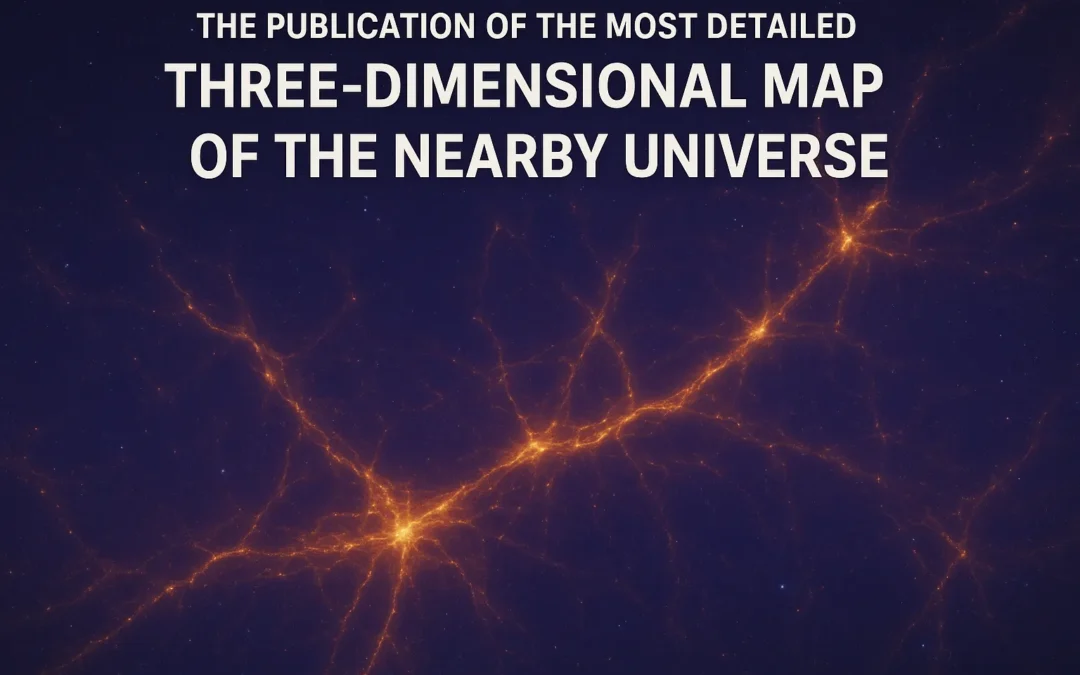
Modern surveys have mapped tens of millions of galaxies, making today’s three-dimensional maps the most detailed ever produced. These maps reveal the intricate “cosmic web” structure, where galaxies are not evenly distributed but instead form interconnected strands stretching across space. By charting the nearby universe with such high precision, astronomers gain critical insights into dark matter distribution, galaxy evolution, and the expansion history of the cosmos.
How Scientists Created the Most Precise 3D Map of the Local Cosmos
To build the most precise 3D map of the local cosmos, scientists combined high-accuracy distance measurements with large-scale sky surveys that track millions of nearby galaxies. The foundation of this breakthrough came from advanced space telescopes and ground-based observatories capable of measuring cosmic distances using techniques such as redshift analysis and standard candle calibration. By calculating how fast galaxies move away from us and comparing that data with refined distance indicators, researchers were able to position galaxies in three-dimensional space with unprecedented precision.
Combining Multi-Survey Data for Higher Accuracy
Instead of relying on a single dataset, researchers merged observations from multiple astronomical surveys to reduce uncertainty and fill observational gaps. These included:
- Spectroscopic surveys to measure galaxy velocities and redshifts
- Infrared and optical imaging to map galaxy positions obscured by cosmic dust
- Space-based parallax measurements to refine nearby distance calculations
By cross-referencing these datasets, scientists corrected distortions caused by gravitational interactions and peculiar velocities, improving the structural accuracy of the map. Advanced algorithms and supercomputer simulations helped align overlapping data and eliminate measurement inconsistencies.
Another key factor in creating the high-resolution 3D cosmic map was the modeling of dark matter distribution. Since dark matter cannot be observed directly, researchers inferred its presence by studying galaxy clustering and gravitational lensing effects. Incorporating these models allowed scientists to better understand the hidden scaffolding shaping local cosmic structures, including galaxy filaments, clusters, and voids.
High-performance computing played a critical role in transforming raw observational data into a coherent three-dimensional model. Machine learning tools processed massive datasets, identified structural patterns, and reconstructed the cosmic web in fine detail. The result is a dynamic and highly accurate representation of the local universe, offering deeper insight into galaxy distribution, large-scale structure formation, and the evolution of nearby cosmic regions.
Key Discoveries Revealed by the New Three-Dimensional Map of the Nearby Universe
The new three-dimensional map of the nearby universe has transformed our understanding of how galaxies are distributed across cosmic space. By providing precise depth measurements in addition to position and motion, astronomers can now visualize the intricate structure of the cosmic web with unprecedented clarity. This detailed mapping highlights the vast filaments of galaxies that stretch across millions of light-years, separated by enormous voids that were previously harder to define. The 3D perspective allows researchers to see how these structures connect and evolve rather than appearing as flat projections on the sky.
Refined View of Dark Matter Distribution
One of the most significant breakthroughs from the new 3D map is a clearer picture of the distribution of dark matter in the nearby universe. By analyzing galaxy motions and gravitational influences, scientists can infer where dark matter is concentrated, revealing dense nodes where galaxy clusters form. This refined mapping strengthens evidence that visible matter follows the gravitational scaffolding created by dark matter, offering deeper insights into how large-scale structures developed after the Big Bang.
Improved Understanding of Galaxy Motions and Cosmic Flows
The three-dimensional data also uncovers detailed patterns of galactic motion and cosmic flows. Instead of viewing galaxies as static points, astronomers can track their velocities and interactions within gravitational fields. This has clarified how galaxy groups move toward massive attractors and how local gravitational dynamics shape the expansion of space in our region of the universe. Such findings help refine models of cosmic expansion and provide more accurate measurements related to the Hubble constant.
Additionally, the map has revealed previously unrecognized galaxy clusters, superclusters, and underdense voids, reshaping the known architecture of our cosmic neighborhood. By identifying subtle connections between structures and pinpointing transitional regions, researchers gain a more cohesive understanding of how matter is organized on vast scales. These discoveries offer essential data for testing cosmological theories and improving simulations of universe formation and evolution.
Why This Publication Marks a Major Breakthrough in Modern Astronomy
This publication represents a major breakthrough in modern astronomy because it fundamentally reshapes how scientists observe, interpret, and model the universe. By combining advanced observational data with cutting-edge analytical techniques, the research bridges long-standing gaps between theory and measurable evidence. Such progress not only refines existing cosmic models but also challenges previously accepted assumptions, opening the door to more precise and comprehensive understandings of astronomical phenomena.
One of the most transformative aspects of this study is its impact on astronomical data analysis and interpretation. The publication introduces methodologies that significantly enhance the accuracy of measurements related to distant celestial bodies, cosmic structures, or high-energy events. This improved precision allows astronomers to detect subtle patterns and anomalies that were previously undetectable, strengthening the reliability of future space research and observational missions.
Key Reasons This Research Stands Out
- Innovative observational techniques that expand the limits of current telescope and sensor capabilities.
- Stronger integration between theoretical physics and empirical data, reducing uncertainty in cosmological models.
- Broader implications for future space exploration, guiding the development of next-generation instruments and missions.
Beyond its immediate findings, the publication sets a new benchmark for collaborative, data-driven astronomy. By leveraging interdisciplinary expertise and large-scale datasets, it accelerates progress in understanding the structure, origin, and evolution of the universe. This shift toward more unified and high-precision research frameworks marks a defining moment in the advancement of modern astronomical science.
What the Most Detailed 3D Map of the Nearby Universe Means for Future Space Research
The creation of the most detailed 3D map of the nearby universe marks a transformative step in modern astronomy and space research. By precisely charting the positions, distances, and motions of millions of galaxies, scientists gain a clearer understanding of the large-scale structure of the cosmos. This enhanced cosmic map allows researchers to trace how matter is distributed across vast distances, revealing galaxy clusters, filaments, and cosmic voids with unprecedented clarity.
For future space missions, this detailed three-dimensional view provides a critical reference framework. Space agencies can use the data to improve telescope targeting, mission planning, and deep-space observation strategies. A more accurate cosmic map supports:
- Improved dark matter and dark energy research through better modeling of galaxy distribution
- Enhanced calibration of distance measurements across intergalactic scales
- More precise simulations of cosmic evolution and structure formation
Advancing Cosmology and Astrophysics
The 3D mapping of the nearby universe also strengthens efforts to test fundamental cosmological theories. By comparing observed structures with theoretical predictions, scientists can refine models of how the universe expanded and evolved over billions of years. This directly impacts research into cosmic expansion rates, gravitational interactions, and the influence of dark energy on large-scale structures.
In addition, the detailed map enhances collaboration between observational astronomy and computational astrophysics. High-resolution data sets enable researchers to run more accurate simulations, identify anomalies, and prioritize regions for further study with next-generation telescopes. As a result, future space research becomes more data-driven, targeted, and capable of answering deeper questions about the universe’s origin, composition, and long-term evolution.
Array