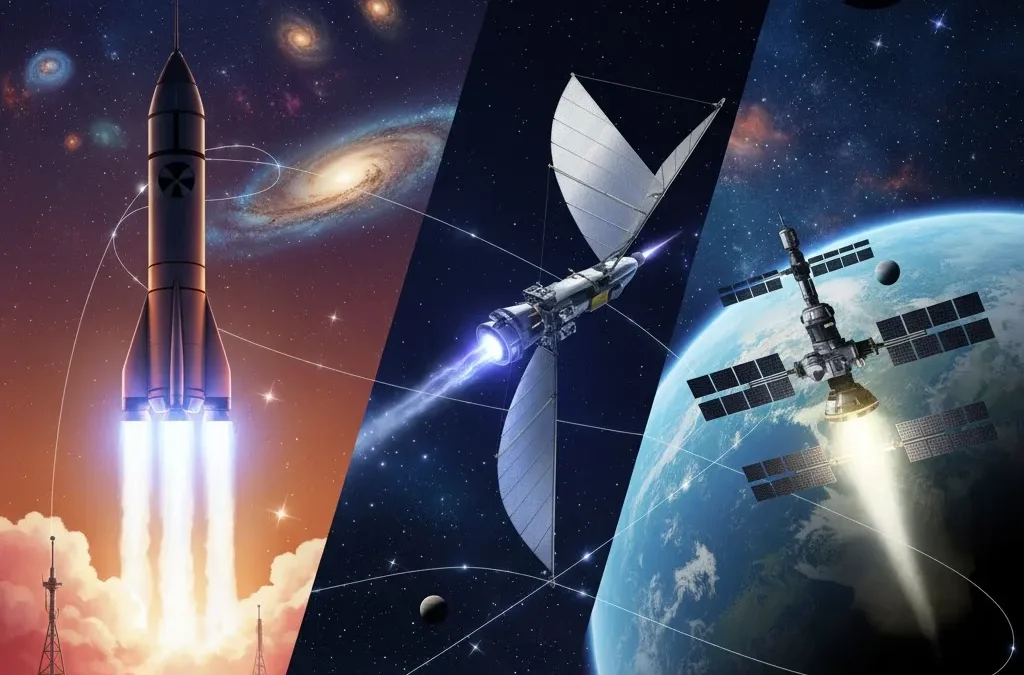
The Evolution of Space Propulsion: Moving Beyond Chemical Fuels
Space propulsion has undergone remarkable transformation since the dawn of the Space Age. For decades, chemical propulsion systems—relying on the combustion of liquid or solid fuels—dominated rocket launches and deep space missions. These engines generate tremendous thrust, making them ideal for escaping Earth’s gravity. However, their efficiency is limited by the energy density of chemical reactions and the significant mass of propellants required, which restricts payload capacities and mission durations.
As space exploration ambitions expanded, so did the need for more efficient propulsion technologies. The limitations of chemical fuels prompted researchers to explore alternative methods that could deliver higher specific impulse, longer operational lifespans, and reduced propellant mass. This search led to the development and testing of electric propulsion systems, such as ion thrusters and Hall-effect thrusters. These systems use electricity—often generated by solar panels or nuclear sources—to accelerate ions and produce thrust. While the thrust produced is much lower than chemical rockets, the efficiency is far superior, making electric propulsion ideal for long-duration missions, satellite station-keeping, and deep space probes.
Emerging propulsion technologies are pushing boundaries even further. Concepts like nuclear thermal propulsion, solar sails, and even experimental plasma drives are being researched for their potential to revolutionize interplanetary travel. Nuclear thermal rockets, for example, promise higher thrust and efficiency by heating propellants with a nuclear reactor. Solar sails harness the momentum of photons from the Sun, offering propulsion without fuel consumption. These innovations signal a paradigm shift in how spacecraft are designed and operated, paving the way for more ambitious missions beyond the confines of our solar system.
Nuclear and Electric Propulsion Technologies: Advancements for 2026 Space Missions
The year 2026 is poised to mark significant progress in space propulsion systems, particularly with the advancement of nuclear and electric propulsion technologies. These cutting-edge systems are at the forefront of enabling deeper, faster, and more efficient space exploration. Agencies like NASA and ESA are investing heavily in nuclear thermal propulsion (NTP) and solar electric propulsion (SEP), aiming to overcome the limitations of conventional chemical rockets. Nuclear propulsion, for instance, can deliver much higher thrust and efficiency, potentially cutting travel time to Mars by nearly half compared to traditional methods.
Electric propulsion technologies are also gaining traction for 2026 missions, especially for satellite constellations and deep-space probes. Systems such as Hall-effect thrusters and ion drives use electric fields to accelerate ions, providing a continuous, efficient thrust over long durations. This approach drastically reduces the amount of propellant needed, allowing spacecraft to carry more scientific instruments or payloads. In upcoming missions, these electric engines will play a crucial role in orbital adjustments, station-keeping, and interplanetary trajectory changes.
Key advancements anticipated for 2026 include the integration of nuclear-electric hybrid propulsion systems. These hybrids combine the high-thrust capability of nuclear systems with the efficiency of electric propulsion, offering flexible solutions for a variety of mission profiles. For example, a spacecraft could use nuclear thermal propulsion to quickly escape Earth’s gravity well and then switch to electric propulsion for efficient cruising in deep space. This dual-mode capability is especially valuable for crewed missions to Mars and robotic exploration of the outer planets.
- Increased efficiency and reduced travel time for interplanetary missions
- Lower propellant requirements, enabling larger payloads and extended missions
- Enhanced maneuverability for satellites and space probes
As space agencies prepare for ambitious 2026 missions, the ongoing development and testing of nuclear and electric propulsion technologies will be pivotal in shaping the next era of space exploration.
Comparing Efficiency and Potential: Why 2026 Missions Favor Nuclear and Electric Propulsion Over Chemical Alternatives
As the space industry gears up for pivotal missions in 2026, a clear trend has emerged: agencies and private companies are increasingly prioritizing nuclear and electric propulsion systems over traditional chemical rockets. This shift is largely due to the superior efficiency and long-term potential offered by these advanced technologies. Chemical propulsion, while reliable and capable of delivering high thrust, is fundamentally limited by its low specific impulse and the massive quantities of propellant required for deep space missions.
Nuclear and electric propulsion systems, on the other hand, offer significantly higher specific impulse, which translates to more efficient use of propellant and the ability to achieve greater velocities over extended periods. For example, nuclear thermal propulsion (NTP) can provide twice the efficiency of conventional chemical rockets, drastically reducing transit times to destinations like Mars. Similarly, electric propulsion—such as ion thrusters or Hall-effect thrusters—enables spacecraft to continuously accelerate over months or years, making them ideal for cargo deliveries, orbital adjustments, and exploration beyond the Moon.
- Fuel Efficiency: Electric and nuclear propulsion systems consume less propellant for the same mission objectives, reducing launch mass and costs.
- Extended Mission Durations: These systems enable spacecraft to operate for longer periods, essential for complex interplanetary or lunar gateway missions planned for 2026.
- Scalability and Flexibility: Electric and nuclear technologies are more adaptable for a variety of mission profiles, from crewed Mars expeditions to robotic asteroid exploration.
The advantages of nuclear and electric propulsion are particularly compelling for the ambitious objectives set for 2026, such as NASA’s Artemis program and various commercial deep space initiatives. As mission planners weigh the benefits, the combination of higher efficiency, reduced costs, and greater operational flexibility makes these advanced propulsion methods the preferred choice over chemical alternatives for the next wave of space exploration.
Array